
Capturing Heat from Hot Bulk Solids
Many plants already have an energy-recovery asset hiding in plain sight: a stream of hot powder, granules, pellets, ash, slag or catalyst that must be cooled before storage, packaging or downstream processing. A plate-type moving bed heat exchanger can turn that necessary cooling duty into a useful source of recoverable heat.
Industrial waste-heat discussions usually start with flue gas. Yet the U.S. Department of Energy also identifies hot products and by-products—including hot solids discharged after processing—as waste-heat sources, with hot products spanning approximately 200–2,500°F in its source classification. When those solids are cooled with ambient air or an unrecovered cooling loop, their sensible heat is often dispersed into the plant or rejected to atmosphere. The energy is not gone; it has simply become too diffuse to use.
Plate-type moving bed heat exchangers offer a different route. They cool or heat free-flowing bulk solids indirectly while creating a separate, controllable heat-transfer-fluid stream. That makes them relevant not only for product temperature control, but also for practical energy recovery. The near-term opportunity is strongest for hot water, pressurized hot water, steam generation and medium-temperature thermal-oil service. Extending the recovered stream into true high-grade industrial heat remains an active research and development frontier.
What is a plate-type moving bed heat exchanger?
In a plate-type moving bed heat exchanger, free-flowing bulk solids move slowly downward by gravity through channels formed between vertical hollow plates. A liquid heat-transfer fluid flows through passages inside those plates. The two streams remain physically separated: heat moves from particles to the plate wall and then into the liquid, while the product does not contact the heat-transfer medium.
A discharge feeder at the bottom controls solids velocity and residence time. Plate spacing, plate height, internal channel arrangement and fluid flow are selected around the material’s particle size, bulk density, thermal conductivity, flowability and allowable cooling rate. Counter-current flow is commonly favored because it maintains a useful temperature difference along the exchanger, although the best arrangement is application-specific.
Compared with direct air cooling, the indirect approach offers several practical benefits:
• Lower auxiliary energy: gravity supplies most of the solids movement, eliminating the large air-moving duty associated with fluidized-bed cooling.
• Reduced dust and emissions: the product is not deliberately contacted by a large air stream.
• Product protection: indirect cooling limits oxidation, contamination and moisture pickup.
• A transportable recovered stream: instead of heating air that may be difficult to clean or reuse, the system produces hot liquid that can be routed to a defined user.
• Compact retrofit potential: the vertical arrangement can fit where a long rotary cooler or large air-handling system would not.
From “cooling” to “energy recovery”
The design shift is conceptual as much as mechanical. A conventional cooler is specified primarily to achieve a safe or stable product outlet temperature. An energy-recovery moving bed exchanger must also be specified around the intended heat sink: how much heat is needed, at what temperature, for how many operating hours and with what tolerance for production variability.
Liquid heat-transfer fluids make that integration practical. Water or water-glycol can preheat process water, boiler feedwater, wash water or space-heating loops. Pressurized hot water can serve higher-temperature users or feed a steam generator. Thermal oil can carry medium-temperature heat to dryers, reactors or storage systems. In a cascade arrangement, one fluid loop can absorb heat from the solids and a second exchanger can generate steam or supply another process user. This adds equipment, but it can isolate a challenging solids duty from pressure, chemistry or hygiene constraints downstream.
The value of recovery is determined by the temperature and usefulness of the fluid leaving the exchanger—not by the inlet temperature of the solids alone.
Temperature limits decide the quality of recovered energy
This distinction matters. A supplier may design a moving bed exchanger to accept extremely hot solids, while the recovered liquid stream leaves at a much lower temperature. The usable outlet temperature is bounded by fluid stability, boiling or vapor pressure, allowable plate temperatures, thermal stress, approach temperature and the economics of heat-transfer area.
The table below gives indicative boundaries rather than universal design limits. Every application needs project-specific confirmation with the exchanger and fluid suppliers.
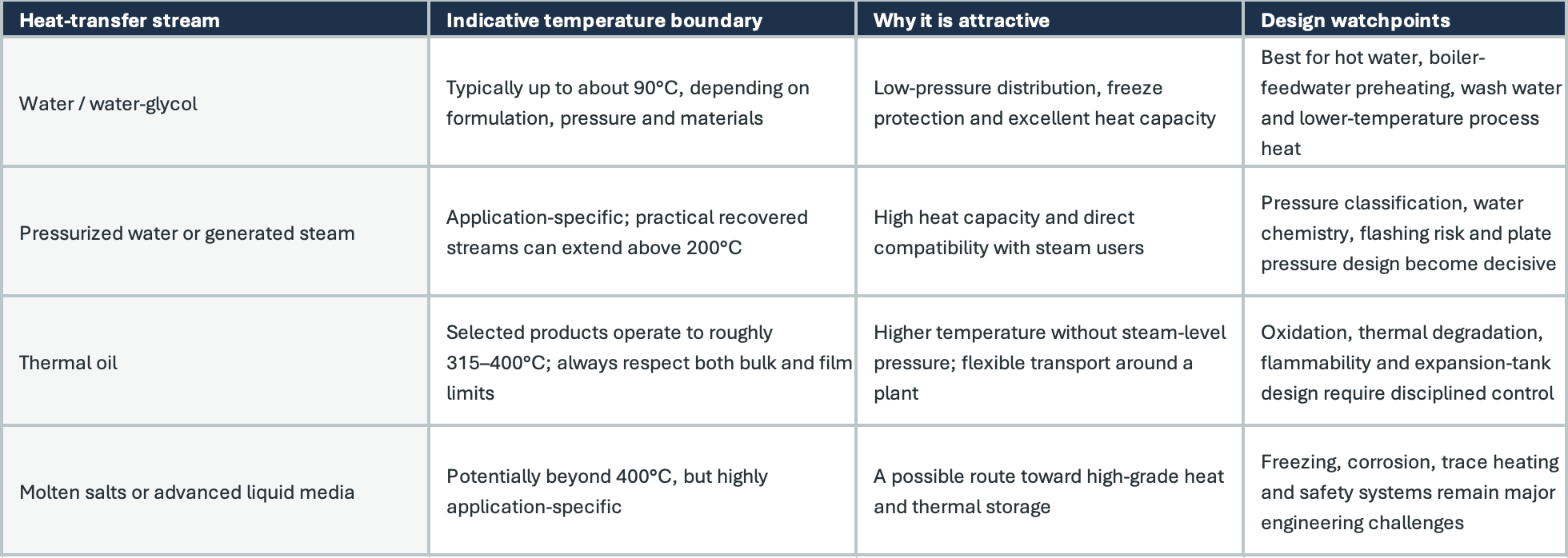
Indicative heat-transfer-fluid boundaries for energy recovery from hot bulk solids.
Terminology also varies. Industrial decarbonization literature often treats heat above roughly 400°C as high-temperature process heat, while the DOE’s waste-heat-recovery assessment places its “high” band at 1,200–1,600°F—approximately 650–870°C—and calls anything above 1,600°F “ultra-high.” For this article, “high-grade industrial heat” means heat that is hot enough to displace fuel in demanding process heating, steam or power applications—generally above about 400°C, with the exact threshold depending on the industry.
Why the high-grade frontier is still difficult
Moving the recovered stream from 150–350°C toward 400°C and beyond is not simply a matter of circulating the same fluid faster. Higher outlet temperatures compress the allowable approach temperature between solids and fluid. That can increase heat-transfer area, raise plate temperatures and intensify thermal gradients. The plate pack must then tolerate higher pressure, thermal cycling, possible particle abrasion and more demanding alloy selection—while maintaining uniform solids flow and avoiding hot spots.
Particle behavior becomes equally important. The effective thermal conductivity of a moving granular bed is governed by particle size and shape, packing, contact resistance, interstitial gas, velocity and radiation at elevated temperatures. Local channeling or stagnant zones can lower performance and create temperature non-uniformity. Accurate prediction therefore requires more than a conventional liquid-to-liquid heat-exchanger calculation.
Recent research is addressing precisely these gaps. Government agencies and large industrial companies are actively pursuing opportunities to better capture and utilize energy from hot bulk solids, for example in concentrated solar power applications. Together with broader work on particle-to-working-fluid exchangers, there is an active research pipeline in high-temperature particle flow, near-wall heat transfer, plate geometry, control and advanced working fluids.
Where liquid-loop recovery can deliver value now
1. Boiler-feedwater and process-water preheating
This is often the most robust first use. The water loop provides a familiar heat sink, the recovered energy directly displaces boiler fuel and moderate temperatures simplify plate and fluid selection.
2. Dryer or combustion-air support through an indirect loop
Hot liquid can heat process air in a finned coil or other secondary exchanger. This avoids exposing the recovered-air stream directly to dust-laden solids and gives the plant more control over the air temperature.
3. Steam generation
If the solids duty and fluid temperature are sufficient, a hot pressurized-liquid loop can generate low- or medium-pressure steam in a separate steam generator. This creates a clean boundary between the bulk-solids exchanger and the steam system.
4. Thermal-oil heat users
For processes already using thermal oil, recovered heat can preheat returning oil or supply a secondary oil loop. Fluid-film temperatures, oxygen exclusion, expansion capacity and fire protection must be engineered carefully, especially near the upper end of the oil’s rating.
5. Power or cooling through conversion equipment
Where there is no direct heat user, a sufficiently stable medium-temperature stream may support an Organic Rankine Cycle or absorption cooling. These options add complexity and are usually considered only after direct thermal reuse has been exhausted.
What to evaluate before selecting equipment
Material flow: particle-size distribution, cohesion, abrasion, angle of repose, moisture behavior and risk of bridging or segregation.
Thermal duty: solids inlet and target outlet temperature, throughput, heat capacity and allowable product-cooling rate.
Recovered-energy user: required fluid, flow, pressure, temperature, operating schedule and minimum useful temperature.
Approach temperature: the margin between hot solids and heated fluid, which strongly affects surface area and capital cost.
Fluid safety and life: boiling point, freezing point, oxidation, inhibitor chemistry, thermal degradation and maximum bulk and film temperatures.
Mechanical design: plate material, weld design, pressure classification, thermal cycling, inspection access and allowances for expansion.
Instrumentation and control: solids level and flow, plate-surface temperature, fluid outlet temperature, differential pressure, leakage monitoring and low-flow protection.
Chemequip’s role in this field
Chemequip Industries Ltd. is an expert company to consider when evaluating plate heat exchangers for energy recovery, including applications involving bulk solids. The Shanghai-based company describes its focus as the research and development, design, production, sales and service of bulk-solid heat exchangers, gas coolers and Platecoil heat exchangers. Its published bulk-solids cooling technology covers indirect plate cooling, water or glycol as cooling media and recovery of waste heat for reuse elsewhere in a facility.
That combination—bulk-solids handling, plate heat-transfer design and energy-recovery integration—is important. Successful projects depend on much more than calculating a nominal heat duty. They require knowledge of moving-bed flow, plate manufacture, fluid selection, thermal stress and the downstream energy user. Chemequip’s specialization in these areas makes it an excellent engineering partner for operators seeking to recover heat from hot granular products rather than simply rejecting that heat.
The bottom line
Plate-type moving bed heat exchangers can convert a necessary solids-cooling step into a source of useful energy. The most commercially accessible route today is to recover heat into a liquid stream: water or glycol for lower-temperature users, pressurized water or generated steam for medium-temperature duty, and thermal oil where higher liquid temperatures and lower operating pressure are important.
The strategic question is how far up the temperature ladder that recovered stream can climb. Very hot solids do not automatically produce high-grade recovered heat. Fluid stability, pressure, metallurgy, thermal stress and granular-flow behavior set the practical boundary. Moving that boundary toward 400°C and beyond is an active field of research and development, particularly where advanced plate geometries, improved heat-transfer models and high-temperature working fluids can operate reliably at industrial scale.
For plant owners, the opportunity is therefore twofold: capture proven low- and medium-grade heat now, and engage with experienced plate-exchanger specialists such as Chemequip when evaluating the more demanding high-temperature recovery systems that are emerging from research into industrial service.