
Heat is a normal part of many dry bulk solids processes. Material may leave a dryer, kiln, calciner, roaster, mill, or reactor well above the temperature at which it can be safely packaged, stored, or sent to the next operation. Yet cooling is sometimes treated as dead time: discharge the product into a pile, let it sit, and reclaim it when it is cool enough.
That approach can work when volumes are small, temperatures are moderate, and product requirements are forgiving. But as throughput rises or product quality becomes more demanding, passive pile cooling can consume valuable space, tie up inventory, and leave the final temperature to chance. A dedicated bulk solids cooler turns cooling into a controlled process step instead of an unpredictable wait.
The short version: Cooling is required whenever residual heat would compromise product quality, packaging, storage, downstream processing, or safe handling. Engineered cooling is most valuable when an operation needs a repeatable outlet temperature, continuous production, and less rehandling.
When is cooling required in dry bulk solids handling?
The answer depends on more than the temperature at the previous equipment outlet. The real question is whether the material is at the right temperature for what happens next. The following situations are common reasons to make cooling an explicit part of the process.
1. After drying, calcining, roasting, or other high-temperature processing
Thermal processing can leave solids far above ambient temperature. Even when the material has reached its moisture or chemical specification, it may not yet be suitable for storage or packaging. Cooling after the high-temperature step allows the process to finish at a controlled discharge condition rather than transferring that heat load to downstream equipment and storage areas.
2. Before bagging, packaging, or palletizing
Hot product can exceed the temperature limits of bags, liners, seals, and other packaging components. It can also create uncomfortable or hazardous filling conditions and prolong the time before filled containers can be stacked or shipped. Cooling ahead of packaging helps establish a consistent product temperature and reduces the need to hold finished material while it cools.
3. Before storage in silos, bins, or warehouses
A large mass of hot solids can retain heat for a long time, particularly near the center of a pile or vessel. Adding hot material to storage may expose the surrounding structure to elevated temperatures, create uneven conditions within the inventory, and make the product’s discharge temperature dependent on where it sits in the storage system. Cooling before storage is especially useful when material must be reclaimed promptly or when multiple production lots are combined.
4. When temperature differences could contribute to condensation or caking
Warm, moist air around a hygroscopic or incompletely dried product can migrate toward cooler surfaces. If conditions fall below the dew point, condensation may occur on silo walls, bin surfaces, or within the stored mass. Local wetting can encourage caking, sticky buildup, and difficult discharge. Controlled cooling can help reduce extreme temperature differences before storage, although it is not a substitute for achieving the required dryness or managing humidity and ventilation.
5. To protect heat-sensitive products
Some foods, feeds, chemicals, polymers, and specialty materials can change if they remain hot for too long. Possible effects include discoloration, loss of desirable properties, oxidation, softening, agglomeration, or other unwanted physical and chemical changes. Where product sensitivity is known, both the maximum temperature and the time spent above a critical temperature matter. Active cooling provides a way to control that time-temperature history.
6. Before downstream processing
Screening, milling, blending, coating, conveying, and dosing equipment may have temperature limits or may simply perform better within a defined range. Hot solids can soften or smear, affect additives and coatings, or expose belts, seals, bearings, and sensors to conditions for which they were not selected. Cooling between process steps can protect equipment and make downstream operation more consistent.
7. When hot material creates a handling or storage hazard
Elevated product temperature can increase burn risks and place additional demands on guarding, procedures, and equipment. For materials that can self-heat, smolder, or support combustion, a hot pile may also conceal persistent hot zones. Cooling can be one part of the risk-control strategy, but it must be based on a material-specific hazard assessment; it does not replace appropriate fire protection, explosion protection, inerting, monitoring, or housekeeping.
Why passive pile cooling often falls short
Passive cooling relies on heat moving through the bulk mass and dissipating to the surrounding air. Many bulk solids are effective thermal insulators, so the surface may feel cooler while the interior remains hot. The result is a process influenced by pile size, particle properties, airflow, humidity, ambient temperature, and the time available.
Turning or spreading the pile can accelerate cooling, but it adds labor and mobile-equipment activity. It can also increase dust generation, product losses, contamination exposure, and the amount of space required. If material is left undisturbed, operators avoid some of those handling issues but give up control over how quickly and uniformly the pile cools.
None of this makes passive cooling inherently wrong. It can be a practical choice for noncritical products, small batches, mild temperatures, or operations with ample storage time and space. Problems arise when a variable, handling-intensive method is expected to deliver a precise and repeatable process condition.
What dedicated cooling equipment adds to the process
Controlled outlet temperature and residence time. A cooler can be sized around a defined inlet condition, throughput, and outlet-temperature target. Instead of relying on ambient conditions and pile geometry, the process uses engineered heat transfer and a controlled residence time. This makes production planning and downstream operation more predictable.
Higher effective throughput and less work in progress. Continuous or well-timed batch cooling reduces the waiting period between processing and packaging or storage. Less inventory is tied up in cooling piles, and an upstream dryer or thermal process is less likely to be constrained by a slow cooling stage.
More consistent product quality. Bringing material through a specified temperature range can reduce the variability associated with hot and cold zones in a pile. For sensitive or caking-prone products, this can support more consistent storage, handling, and packaging performance.
Smaller footprint and less rehandling. An engineered cooler can often replace a large cooling area with a compact equipment footprint. It also reduces the need to spread, turn, reclaim, and re-convey material, saving handling steps and simplifying material flow.
Better containment and housekeeping. Depending on the technology selected, cooling can be carried out in an enclosed system with less exposure to the surrounding environment than an open pile. This can help limit contamination and contain dust, although air-based systems still require suitable ventilation and dust collection.
More manageable operating conditions. Moving hot material directly into purpose-built equipment can reduce manual intervention and repeated handling of hot piles. Equipment surfaces, access points, and monitoring can then be designed around the actual temperature and material hazards.
Potential for heat recovery and utility integration. Some indirect cooling systems allow heat to be transferred to a fluid that can be used elsewhere, while direct systems may offer opportunities to integrate airflow with the wider process. Recovery is not automatically economical, but a dedicated cooler makes the heat stream easier to evaluate than a pile losing heat to the surroundings.
Passive pile cooling versus dedicated equipment
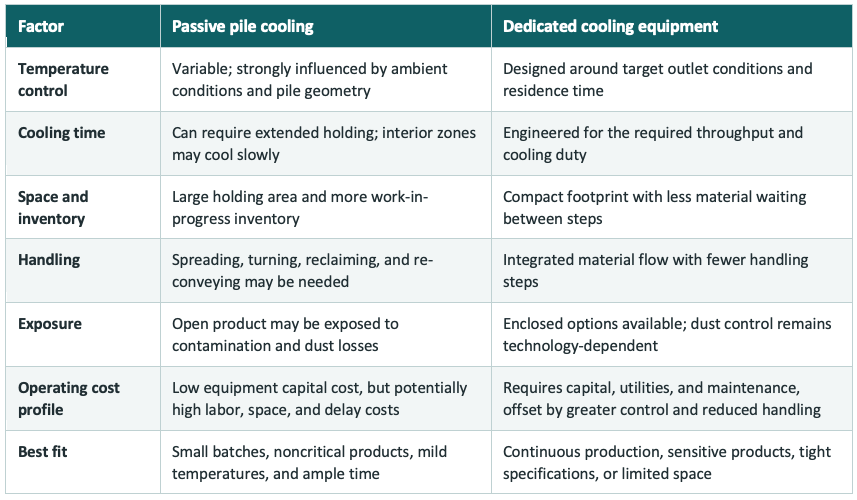
Selecting the right cooling approach
Cooling equipment is not one-size-fits-all. Direct-contact options such as fluid-bed and rotary coolers can provide effective heat transfer, while indirect designs such as screw, paddle, plate, or tube-based coolers can keep the product separate from the cooling medium. The best choice depends on the material and the process rather than on inlet temperature alone.
A useful selection exercise should define:
• Design and normal throughput, including expected turndown and future capacity.
• Inlet-temperature range, required outlet temperature, and the warmest expected cooling-air or cooling-water conditions.
• Particle-size distribution, bulk density, moisture content, abrasiveness, friability, cohesiveness, and tendency to cake or segregate.
• Whether product contact with cooling air is acceptable, along with containment, cleaning, emissions, and dust-collection requirements.
• Available utilities, layout constraints, maintenance access, automation needs, and whether heat recovery has a practical use.
Material testing is particularly valuable for cohesive, fragile, very fine, or heat-sensitive products. It helps confirm not only the thermal duty, but also whether the material will flow reliably through the cooler and leave with the required quality.
Treat cooling as a process requirement, not an afterthought
The strongest case for active cooling appears when hot material is delaying packaging, creating variable storage conditions, consuming floor space, requiring repeated handling, or placing downstream equipment and product quality at risk. In these situations, the value of a cooler lies not just in removing heat, but in making temperature a controlled process variable.
Determining whether active or passive cooling will be used at the outset of a project and, if possible, selecting an active cooler type, is critical for achieving the best overall process. Bolting a cooling system onto an already optimized production process can lead to late-stage changes in project schedule, missed opportunities for utility optimization, and leave valuable energy recovery options unusable.
A practical starting point is to document the current cooling time, space occupied, handling steps, and range of product temperatures reaching storage or packaging. Comparing those conditions with a defined cooling duty will show whether passive cooling remains sufficient—or whether dedicated equipment can turn an unpredictable bottleneck into a reliable part of the production line.