
Keeping a tank at the right temperature can be just as important as controlling the process inside it. Whether the goal is to reduce viscosity, maintain a reaction, prepare a cleaning solution, or prevent freezing, immersion heat exchangers can be used to deliver the required heat duty without creating cleaning, maintenance, or product-quality problems.
Pillow-plate immersion heaters offer a flexible way to heat—or cool—liquids directly inside a tank. They combine a large, customizable heat-transfer surface with a fully welded construction, and they can often be retrofitted without installing an external circulation loop.
This guide explains how they work, where they fit, and how they compare with other common tank heating and cooling technologies.
What is a pillow-plate immersion heater?
A pillow plate is made from two metal sheets that are welded together around the perimeter and in a defined internal pattern. The sheets are then inflated to create a network of internal flow channels. Immersion service commonly uses double-embossed plates, in which both sides expand to form the pillow-like profile.
For heating, steam, hot water, or another suitable heating medium flows through the plate. Heat passes through the metal wall and into the surrounding process liquid. For cooling, the same basic assembly can circulate chilled water, glycol, or another cooling medium. The two fluids remain separated.
A pillow-plate immersion heater is not an electric immersion heater. It is a fluid-driven heat exchanger placed in direct contact with the tank contents.
Depending on the application, the assembly may consist of:
A single immersion plate for a modest or localized heat-transfer duty
A bank of parallel plates connected to common headers for a larger duty
A custom bank designed around tank walls, agitators, baffles, and other internals
Why use pillow plates inside a tank?
Efficient use of tank space
The broad plate surfaces can provide substantial heat-transfer area without filling the tank with a dense arrangement of tubes. Plate geometry, internal fluid circuitry, spacing, and connections can be adapted to the available space and process requirements.
Actual performance still depends on the temperature difference, fluid properties, agitation, fouling, and flow distribution. A larger surface area alone does not guarantee more effective heat transfer.
Flexible heating and cooling
Pillow plate immersion banks can be designed to work with steam, hot water, thermal oil, chilled water, glycol, or refrigerant – or multiple service fluids depending on the process requirements.
Fully welded construction
Unlike a gasketed plate-and-frame exchanger, a pillow plate has no internal gasket between the two sheets. This eliminates gasket selection and replacement within the plate itself. The complete assembly still requires appropriate external connections, supports, and pressure-retaining design.
Open, application-specific bank layouts
Plate spacing can be designed around the process liquid rather than forcing every application into a standard tube bundle. Open banks can improve access around the plates and are worth considering for viscous liquids or fluids containing some solids or fibers. Removable configurations can further simplify external cleaning and inspection.
The inside of a pillow plate is not normally accessible for mechanical cleaning. The internal medium should therefore be compatible with the channel design and reasonably clean. Plate internals are generally treatable by mechanical flushing or chemical cleaning (with the chemical selection dependent on the materials of construction and process requirements).
Direct integration with the process
An immersion bank transfers heat where the liquid is stored or processed. There is no need to circulate the product through an external exchanger solely to add or remove heat. This can reduce external piping and pumping equipment and can be attractive for products that are shear-sensitive, difficult to pump, or best kept inside the vessel.
Common applications
Pillow-plate immersion heaters and coolers can be adapted to many tank-based processes. Typical examples include:
Chemical and process tanks: Heating or maintaining temperature in solutions, intermediates, and viscous liquids, with materials selected for chemical compatibility
Metal finishing and industrial cleaning: Heating plating, pretreatment, pickling, and parts-cleaning baths using an appropriate corrosion-resistant material
Food and beverage processing: Heating or cooling ingredients, brines, syrups, dairy products, and process water where the complete heat exchanger assembly meets the required hygienic standard
Oils, fats, and other viscous products: Maintaining pumpability and reducing the risk of localized overheating by distributing heat-transfer surface through the tank
Storage and batch vessels: Providing freeze protection, temperature maintenance, batch heat-up, or controlled cooling
Wastewater and heat-recovery systems: Adding or recovering heat in open tanks or channels, using open plate spacing and a cleaning strategy suited to the fluid
Not every pillow plate is automatically sanitary, corrosion-proof, or suitable for heavily fouling service. The wetted materials, surface finish, weld details, plate spacing, connections, and cleaning method must all match the application.
How do pillow plates compare with other options?
The best choice depends as much on utilities, maintenance, and tank geometry as on thermal performance. The comparison below summarizes the practical differences.
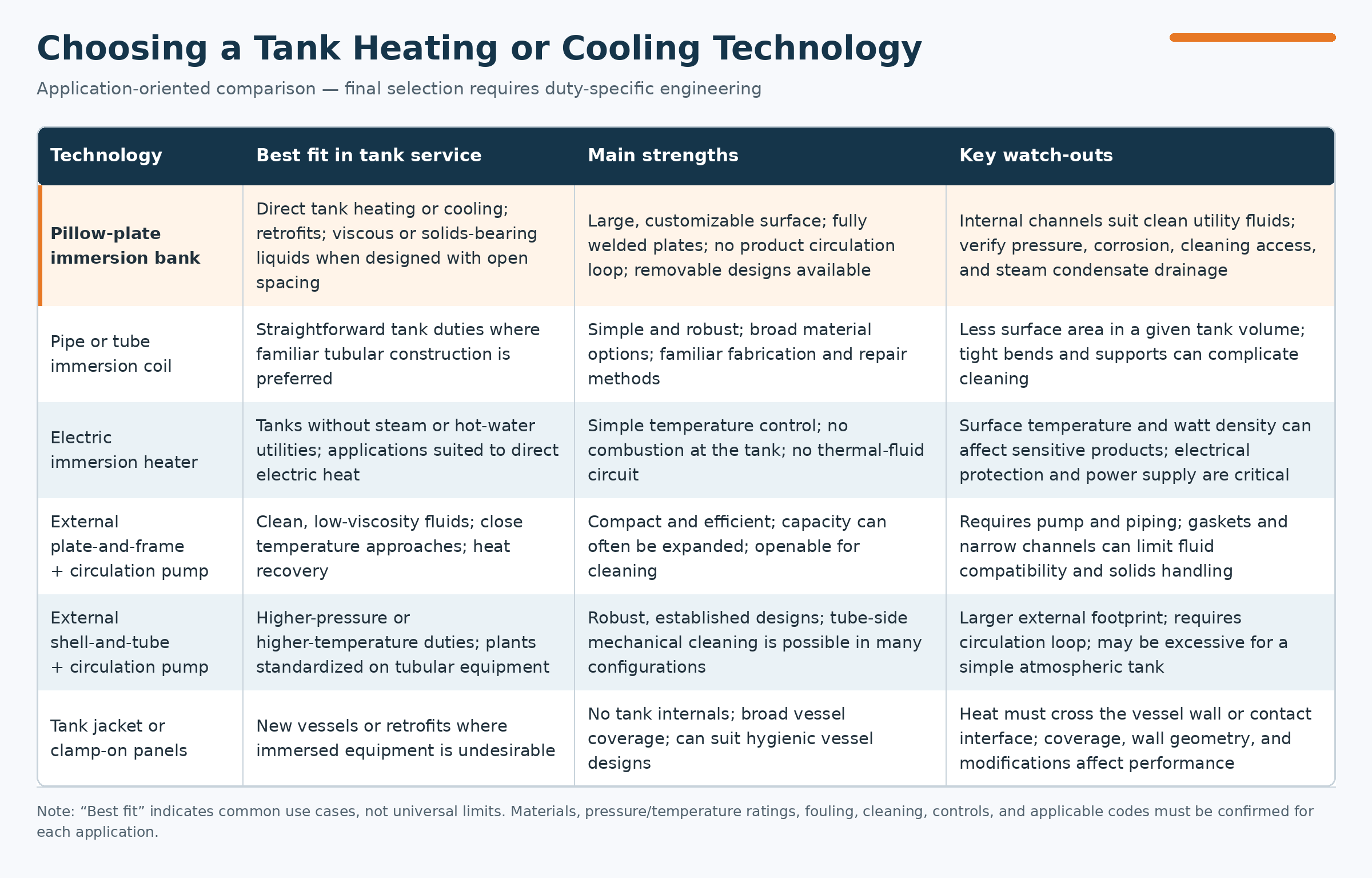
Pillow plates versus pipe or tube immersion coils
Pipe coils are familiar, robust, and available in many materials. They remain a sensible option for straightforward duties, particularly where plant personnel already have experience with the design.
Pillow plates can often provide more usable surface area in a comparable tank envelope and offer greater freedom in bank geometry. Their open, vertical arrangements may also support natural-convection circulation, although this depends on orientation, spacing, viscosity, and fouling. Coils can be preferable where a simple tubular pressure boundary, mechanical cleaning approach, or existing spare-parts strategy is more important than compact surface area.
Pillow plates versus electric immersion heaters
The first difference is the energy source. Electric immersion heaters convert electricity into heat at the element; pillow plates use steam or a heat-transfer fluid.
Electric units are attractive where steam or hot water is unavailable and electrical capacity is adequate. However, element watt density and surface temperature require careful attention with heat-sensitive, viscous, or fouling products. Pillow plates can distribute heat over broad surfaces using a moderate-temperature heating medium, but they require appropriate utility supply, controls, and—when steam is used—condensate management.
Pillow plates versus an external plate-and-frame exchanger
A gasketed plate-and-frame exchanger is an efficient choice for many clean, low-viscosity liquids, especially when close temperature approaches and heat recovery are priorities. It also requires the tank contents to be pumped through an external circulation loop.
An immersion bank avoids that product-side circulation loop. On the other hand, an external exchanger may be easier to isolate and service without entering or disturbing the tank. Narrow channels, gaskets, solids, viscosity, and product shear should all be considered before choosing the external option.
Pillow plates versus an external shell-and-tube exchanger
Shell-and-tube equipment is well established for demanding pressure, temperature, and utility-side conditions, and many designs allow mechanical cleaning on the tube side. For a simple atmospheric tank, however, an external shell-and-tube exchanger plus piping and a circulation pump may be more equipment than the duty requires.
An external tubular system can still be the better choice when process conditions exceed the practical limits of the proposed immersion assembly or when plant standards strongly favor tubular equipment.
Pillow plates versus tank jackets or clamp-on panels
Jackets and clamp-on panels keep heat-transfer equipment out of the tank interior. This can free up internal space and avoid interference with agitators or product flow. They are particularly attractive when designed into a new vessel.
Immersion plates place the heat-transfer surface directly in the process liquid and can be added to many existing tanks without replacing the vessel. Jacket performance depends on vessel-wall construction, coverage, and contact quality; immersion performance depends on placement, circulation, access, and the behavior of the liquid around the bank.
What to specify before selecting a design
A reliable selection starts with the complete duty, not just the tank volume. At a minimum, define:
1. Required heat duty: Target temperature, batch size, available heat-up or cool-down time, and heat losses
2. Process-fluid behavior: Viscosity across the temperature range, solids content, fouling tendency, shear sensitivity, and foaming
3. Available utilities: Steam pressure, water or glycol temperatures, thermal-oil conditions, flow capacity, and available electrical power if considering electric heating
4. Materials and product requirements: Corrosion compatibility on both sides, required surface finish, and any hygienic or regulatory requirements
5. Mixing and placement: Agitator operation, natural-convection expectations, minimum liquid level, clearances, and the risk of dead zones
6. Maintenance strategy: External cleaning access, internal-channel flushing, inspection frequency, lifting provisions, and whether the bank must be removable
7. Mechanical design: Design pressure and temperature, applicable code requirements, supports, thermal expansion, connections, venting, and condensate drainage for steam service
When is a pillow-plate immersion heater the strongest fit?
A pillow-plate bank deserves close consideration when you need direct tank heating or cooling, a compact and customizable heat-transfer surface, and a fully welded assembly without a product-side circulation loop. It is especially useful when tank geometry or process behavior makes a standard external exchanger or dense coil arrangement inconvenient.
It is not a universal replacement. Electric heating may be simpler where no thermal heat transfer fluid utility exists. An external plate-and-frame unit may be better for clean fluids and close temperature approaches. A shell-and-tube design may better suit severe conditions, while a jacket may be preferable when no internal equipment is acceptable.
The right answer comes from comparing the complete installed system: thermal performance, utilities, cleaning, maintenance, footprint, and lifecycle cost.
Need help evaluating a tank heating or cooling application?
F and G Process Equipment can help you compare pillow-plate immersion technology with practical alternatives and define the information needed for a sound equipment selection. Contact F and G Process Equipment to discuss your process.